
Concrete Block Wall Installation in Lancaster, CA
Lancaster Concrete Company builds concrete block walls for homeowners throughout Lancaster and the surrounding Antelope Valley. Every wall is built to provide lasting privacy, security, and property definition.
500+
Concrete Jobs Completed
25+
Years in Business
4.9 ★
Average Google Rating
Understanding Your Block Wall Options
A concrete block wall provides lasting privacy, security, and clear property boundaries for homeowners throughout Lancaster. Homeowners typically consider a block wall when they need to define a property line, create separation from a neighboring lot, add privacy to a backyard, or replace an aging wood fence that has deteriorated in our climate.
A properly built block wall does more than mark a boundary. It offers a level of security and privacy that wood fencing simply cannot match, since block construction is far more difficult to breach and does not sag, lean, or rot over time. It also provides genuine noise reduction from neighboring properties or nearby streets, which many homeowners find valuable in creating a more private backyard environment.
Beyond function, a well-built block wall adds real value and curb appeal to a property. Unlike wood fencing, which typically needs replacement every 15 to 20 years in our climate, a properly constructed block wall can last for generations with minimal maintenance, making it a genuine long-term investment rather than a recurring expense.
Deciding Between Fencing and a Block Wall
Homeowners typically pursue a block wall when an existing wood fence has deteriorated beyond simple repair, when a new property requires a boundary wall for the first time, or when additional privacy and security become priorities, such as after installing a pool or adding outdoor living space that faces a neighboring property.
Choosing to delay a needed block wall, particularly when replacing a failing wood fence, often means continuing to deal with security gaps, privacy issues, and the ongoing costs of patching or propping up wood sections that are simply past their useful life. Wood fencing in our climate is especially prone to warping and cracking due to intense sun exposure and rapid temperature swings between day and night, meaning the cycle of repair tends to repeat every few years without ever fully solving the underlying problem.
For homeowners weighing their options, it helps to consider the long-term cost comparison between a wood fence requiring periodic replacement and a block wall built once with minimal upkeep. While the upfront investment in a block wall is higher, most homeowners find the total cost over 20 or 30 years favors block construction significantly, in addition to the added security and noise reduction benefits it provides.
Our Concrete Block Wall Installation Process
We begin every block wall project by confirming the exact property line and any local code requirements related to wall height, setbacks, and design, since these regulations vary depending on location and whether the wall faces a neighboring property or a public right-of-way. Accurately establishing the layout upfront prevents costly issues later in the project.
Once the layout is confirmed, we excavate and pour a properly reinforced concrete footing below the frost line, which serves as the foundation the entire wall will rest on. A footing built to the correct depth and specification is essential for preventing the wall from shifting or cracking due to soil movement over time.
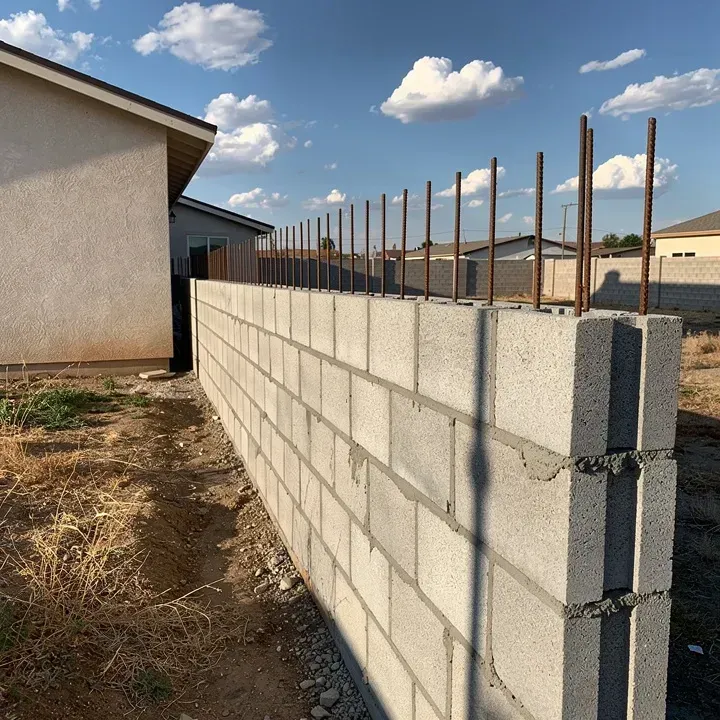
With the footing cured, we begin laying the concrete blocks in a running bond pattern, inserting vertical rebar through the block cores and filling them with grout at specified intervals to tie the wall together into a single, structurally sound unit rather than a series of loosely stacked blocks. The wall is built up to the required height, capped with a finished top course, and any desired texture, color, or stucco finish is applied to complete the look.
What Affects the Cost of a Block Wall
Several factors influence the final cost of a block wall project, starting with the total linear footage and height of the wall being built. Taller walls require deeper footings and additional reinforcement, which increases both material and labor costs compared to a standard height privacy wall.
Site conditions play a meaningful role as well, since walls built on sloped terrain or difficult soil conditions may require additional engineering and footing work to ensure stability. Access to the work area also matters, as walls built along tight side yards or areas with limited equipment access can require more manual labor to complete.
The finish you choose affects pricing too. A standard exposed block finish is the most affordable option, while stucco coating, decorative capping, or color integration add to the overall cost but provide a more polished, finished appearance. Any required permitting, particularly for walls exceeding standard height limits or those located near a public right-of-way, can also factor into the total investment.
We provide a detailed, itemized estimate before any work begins so you understand exactly what is involved and why.
Frequently Asked Questions
Do I need a permit to build a block wall?
In most cases, yes, particularly for walls exceeding six feet in height or those located near a public right-of-way. Requirements vary depending on the specific location and height of the wall. We handle the permitting process for projects that require it, ensuring the finished wall meets all applicable local code requirements.
How do you determine the exact property line before building?
We rely on existing property surveys, recorded plot maps, or visible markers when available to establish the property line before construction begins. If there is any uncertainty about the exact boundary, we recommend a professional survey to avoid disputes with neighbors, since building even slightly over a property line can create legal complications down the road.
How tall can my block wall be?
Standard residential block walls in Lancaster typically max out around six feet without requiring additional permitting or setback considerations, though this can vary depending on your specific property and whether the wall faces a street, alley, or neighboring yard. We confirm the applicable height limits for your property during the planning stage of your project.
Can a block wall be built on a sloped property?
Yes, block walls can be built on sloped terrain, though it requires additional engineering considerations such as stepped footings that follow the grade of the land. This adds some complexity and cost compared to a wall on flat ground, but it is a routine part of block wall construction that our team handles regularly throughout the hillier areas of the Antelope Valley.
Ready to Get Started on Your Concrete Project?
From new patios and stamped concrete designs to solid foundations and cracked driveway repairs, Lancaster Concrete Company is ready to help with whatever your property needs. Give us a call or send us an email today for a free, no-obligation estimate. Our team will walk you through the process, answer your questions, and get your project scheduled quickly, so you can stop worrying about your concrete and start enjoying the results.


Contact
(661) 718-4856
Mon–Sat: 6am–7pm
Lancaster, CA
About Us
Lancaster Concrete Company is a locally owned and operated business proudly serving homeowners throughout Lancaster, Palmdale, Quartz Hill, Rosamond, Acton, Littlerock, and the surrounding Antelope Valley. With over 25 years of experience, our team is committed to quality workmanship, honest pricing, and building lasting relationships with the communities we serve. We treat every property with the same care and respect we would want for our own homes.
© Copyright 2026 Lancaster Concrete Company. All rights reserved.
© Copyright 2026 Lancaster Concrete Company.
All rights reserved.